
If you’ve ever wondered how modern businesses make crystal-clear phone calls without being tied to old copper telephone lines, the answer is often SIP trunking. It’s the backbone of many modern communication systems, enabling companies to stay connected efficiently and cost-effectively.
In simple terms:
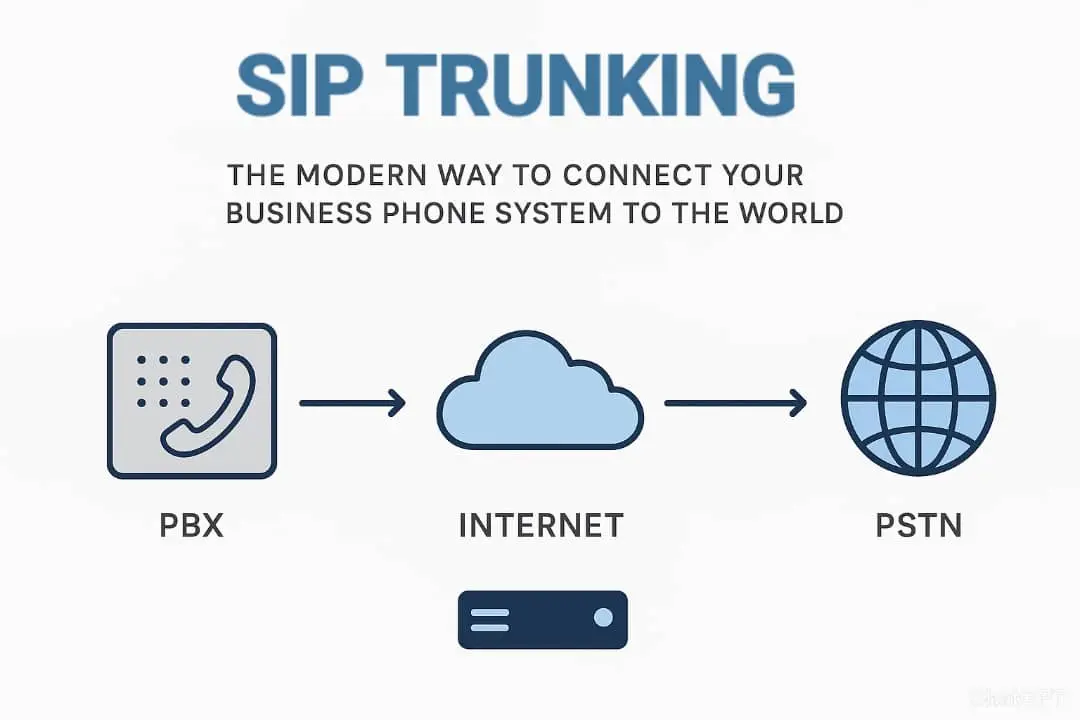
SIP trunking is a communications technology that lets businesses make and receive calls via the internet rather than traditional phone lines. It uses a protocol called SIP (Session Initiation Protocol) to connect your company’s PBX (Private Branch Exchange) to the PSTN (Public Switched Telephone Network) through a VoIP service provider.
Why businesses choose SIP trunking:
- Cost Efficiency-You eliminate the need for physical lines, paying only for the channels you need. International and long-distance calls are significantly cheaper.
- Scalability-Add or remove call channels instantly without installing new hardware.
- Flexibility-Staff can make and receive business calls from anywhere with an internet connection-ideal for remote and hybrid teams.
- Advanced Features-Supports HD voice, video conferencing, instant messaging, and intelligent call routing for better customer service.
- Business Continuity - If your office internet goes down, calls can automatically reroute to mobile devices or backup sites.
How it works:
Think of SIP trunking as a digital bridge between your internal phone system and the global telephone network.
- Instead of multiple physical lines, a single high-speed internet connection carries multiple voice channels simultaneously.
- Calls are converted into digital packets and securely transmitted over the internet to your provider, who connects them to the PSTN or another VoIP network.
Example scenario:
Your company has an IP-enabled PBX. With SIP trunking, you can call a landline in Lusaka, a mobile in Cape Town, or even host a video conference with a partner in London-without needing different lines for each service. It’s one seamless, cost-effective connection.
In today’s fast-paced business environment, SIP trunking isn’t just a replacement for traditional phone lines—it’s a smarter, more adaptable foundation for unified communications.